
In Las Vegas, builder-grade garage door springs last 5 to 7 years on a busy household door (about 10,000 cycles), steel rollers 3 to 5 years, cables 8 to 12, openers 10 to 15, and steel panels 20 to 30. Heat and dust wear seals and rollers fastest; the springs are the part that actually breaks.
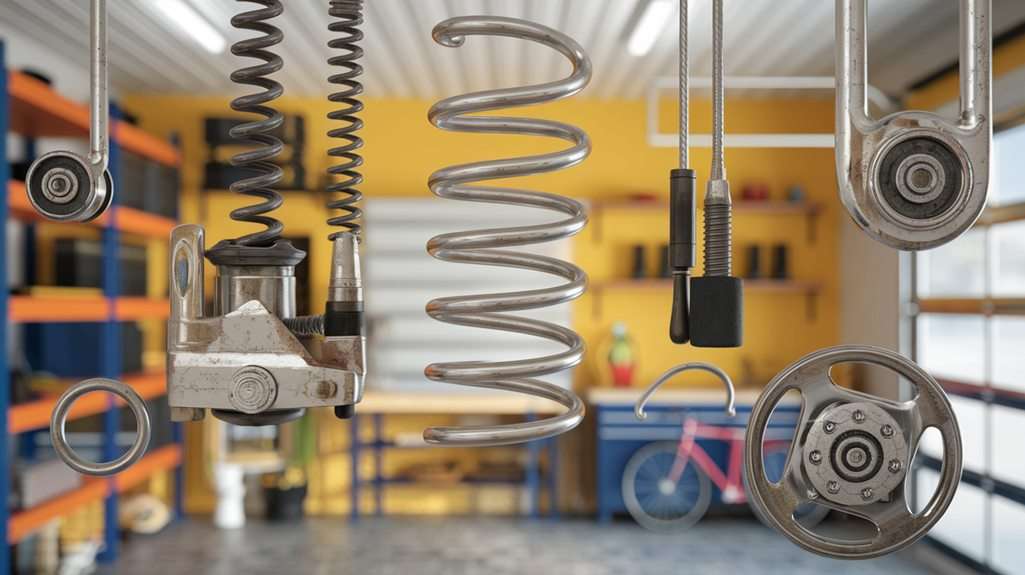
Quick reference: how long each part lasts here
| Component | Typical lifespan in Las Vegas |
|---|---|
| Torsion springs (builder grade, 10,000 cycles) | 5 to 7 years busy door, 10 to 12 light use |
| High-cycle torsion springs (20,000 to 30,000 cycles) | 12 to 20 years |
| Lift cables | 8 to 12 years |
| Rollers, steel | 3 to 5 years |
| Rollers, sealed nylon | 10 to 12 years |
| Hinges | 15 to 20 years |
| Opener (motor head and board) | 10 to 15 years |
| Safety sensors | 10 to 15 years |
| Bottom seal and weatherstrip | 2 to 4 years |
| Steel door sections | 20 to 30 years |
| Tracks | Life of the door unless bent |
All lifespans are typical ranges for a household door opened 4 to 6 times a day; every replacement is priced by the job with a written quote first.
Torsion springs: the part that fails
Springs do the lifting. A 16 by 7 steel door weighs 130 to 250 pounds, and the pair of torsion springs above it hold almost all of that so the opener only has to guide the door. Springs are rated in cycles, one open and one close, and the springs installed by builders across Henderson, North Las Vegas, and Summerlin are 10,000-cycle springs. Two cars leaving and returning twice a day is about 1,500 cycles a year, so the math lands at 6 to 7 years. A one-car household on a lightly used door stretches that to 10 or 12. Heat is not what kills them; fatigue is, though sprinkler overspray on a garage wall can rust the coils and shorten the count.
Signs a spring is near the end: the door feels heavy on the manual release, the opener strains or stops partway, the door sits crooked, there is a 1 to 2 inch gap in the coil where it has stretched, or you hear a single loud bang from the garage. That bang is the spring breaking, and the door will not open afterward.
When to replace: at the first sign above, and always both springs at once on a two-spring door, because the second one has the same cycle count and fails within months. Ask for high-cycle springs rated 20,000 to 30,000 cycles; the upcharge is small and it doubles or triples the interval. Spring work is under hundreds of pounds of tension and is not a homeowner job; our garage door spring repair page covers what the visit involves and why both springs are replaced together.
Cables and drums
The two lift cables run from the bottom brackets up to the drums on the spring shaft. They rarely fail on their own; they fail when a spring breaks and the sudden load frays them, or when they rust at the bottom bracket where a sprinkler hits. Look for broken strands, a cable that has jumped the drum, or a door that hangs crooked. Cables are inexpensive to replace and should be swapped whenever springs are replaced, since the labor is already paid for.
Rollers and hinges
The factory steel rollers on most tract-home doors have exposed ball bearings, and Las Vegas dust grinds them. At 3 to 5 years they get loud, at 6 or 7 they flat-spot or the stem wears loose in the hinge. The upgrade is a sealed nylon roller with a 10 or 13 ball bearing, which runs quiet and lasts 10 to 12 years. Hinges last much longer, but check the numbered hinges on the end stiles for cracks near the knuckle every year; a cracked hinge lets a section fold wrong and bends the track.
The opener
A garage door opener lasts 10 to 15 years here. The motor itself is rarely what dies; the logic board and capacitor give out after years of summers in a 110 to 120 degree garage, and the gear in older chain-drive units strips. Signs are a hum with no movement, the door opening a foot and stopping, a remote that works only up close, or a unit that resets its settings on its own. If the opener is more than 12 years old and needs a board, a new opener with a belt drive, battery backup, and smartphone control usually costs less than the repair once labor is included. Details are on our garage door opener installation page. Any opener from before 1993 has no safety sensors and should be replaced regardless; an opener that reverses for no reason is often a force setting or a dirty sensor, which our post on adjusting opener sensitivity explains.
Seals and weatherstrip: the shortest life in the desert
The vinyl bottom seal and the side and top weatherstrip take the worst of the UV. In Las Vegas they dry out, flatten, and crack in 2 to 4 years, well ahead of the 5 to 8 years they last in milder climates. The result is daylight under the door, dust on everything in the garage, and an open invitation for scorpions and roof rats, covered in our guide to keeping pests out through the garage door. Check the seal each fall: if you can see light along the bottom with the door closed, replace it.
Sections, panels, and the door itself
Steel sections last 20 to 30 years. The 24 and 25 gauge non-insulated pan doors on homes built from 1990 to 2008 are at the low end of that range, and the common failure is rust-through at the bottom section from sprinkler spray. Insulated doors can delaminate, where the outer skin lets go of the foam and flexes or bubbles. Wood doors, uncommon here for good reason, crack and check in our 5 to 10 percent humidity and need refinishing every 2 to 3 years. A single damaged section can sometimes be replaced if the model is still made, but once a door is past 20 years and shows rust or delamination, a new door is the better spend. Our garage door installation page covers options and timing, and if the door is sound but faded, see our guide to painting a garage door in Las Vegas.
A Las Vegas maintenance calendar
- Monthly: pull the release cord with the door closed and lift it by hand. It should rise smoothly and stay put at waist height. If it drifts down or feels heavy, the springs are losing tension. Test the safety sensors by blocking the beam.
- Every 3 months: lubricate the rollers, hinges, springs, and the opener rail with a silicone or white lithium spray. Do not use WD-40, which strips grease and attracts dust. Wipe the sensor lenses.
- Each fall: inspect the bottom seal for cracks and daylight, look at cables for fraying at the bottom bracket, and tighten the track and hinge bolts, which loosen through 60 degree daily temperature swings.
- Yearly: have a technician balance the door and check spring tension, especially on doors 5 or more years old in high-use households.
When to call Supreme Garage Doors
Call (702) 356-1697 if the door feels heavy or crooked, if you heard a bang from the garage, if the opener hums without moving the door, or if it has been more than a year since anyone checked the springs on a door that is 5 or more years old. Supreme Garage Doors answers 24/7, reaches most homes in Las Vegas, Henderson, North Las Vegas, and Enterprise the same day, and gives you a written quote before any work starts. A standard garage door repair visit includes a check of every component in the table above.
Frequently asked questions
How long do garage door springs last in Las Vegas?
Builder-grade torsion springs are rated for 10,000 cycles, which is 5 to 7 years for a household that opens the door 4 to 6 times a day, or 10 to 12 years with light use. High-cycle springs rated 20,000 to 30,000 cycles last two to three times longer. Fatigue, not heat, is what wears them out, though sprinkler overspray can rust the coils.
What are the signs that garage door springs are worn out?
The door feels heavy when you lift it by hand with the release cord pulled, the opener strains or stops partway, the door sits crooked or drifts down instead of staying put at waist height, or you can see a visible gap in the coil. A loud bang from the garage means a spring has already broken and the door should not be operated.
Should I replace both garage door springs at the same time?
Yes. On a two-spring door both springs were installed together and have the same cycle count, so when one breaks the other is typically within months of failing. Replacing both in one visit costs less than two service calls and lets the technician balance the door correctly with a matched pair.
How long does a garage door opener last?
Most residential openers last 10 to 15 years. In Las Vegas the logic board and capacitor usually fail before the motor because of summer garage temperatures of 110 to 120 degrees. If an opener is over 12 years old and needs a board, a new belt-drive unit with battery backup and smartphone control usually costs less than the repair with labor.
How often should I lubricate my garage door in the desert?
Every 3 months, using a silicone or white lithium spray on the rollers, hinges, springs, and opener rail. Avoid WD-40, which removes grease and attracts dust. Dust is the reason Las Vegas doors need lubrication more often than doors in humid climates, and it is also why sealed nylon rollers outlast open steel rollers here.
When should I replace the whole garage door instead of parts?
When the door is past 20 years and shows rust-through at the bottom section, delamination on an insulated door, or a bowed or cracked section, or when you have paid for three or more repairs in two years. A new 16 by 7 steel door is priced by the job, with a written quote covering the door, tracks, springs, labor and haul-away.
3 Responses