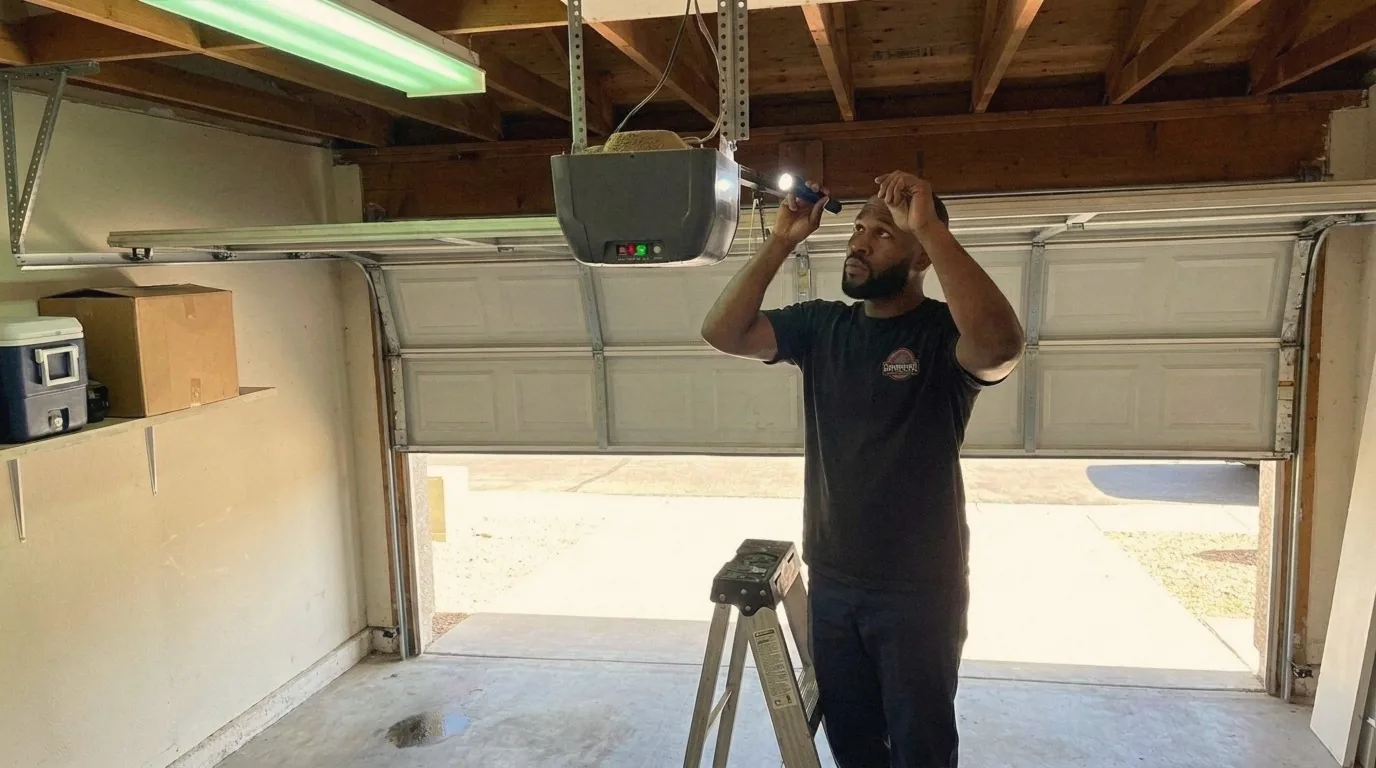
Chamberlain garage door opener troubleshooting starts with four things: the safety sensors at the bottom of the tracks, the LOCK button on the wall control, power to the motor unit, or a dead remote battery. The diagnostic LED on the motor unit (the UP and DOWN arrows on Security+ 2.0 and 3.0 models) flashes a code that names the fault. Count the flashes and match them to the table below to see whether this is a quick homeowner fix or a call to Supreme Garage Doors.
If the opener’s main light blinks 10 times when you press the button, it is a sensor problem; 2 blinks means LOCK mode is on (both are covered below). To know which code table applies, look at the back of the motor unit: UP and DOWN arrow buttons mean the first table, a lone LED beside the LEARN button means the second. This guide covers residential Chamberlain belt drive and chain drive openers as installed in Las Vegas valley homes. Every code and its meaning comes from Chamberlain Group’s own support documentation; the Las Vegas notes and the do-it-yourself versus technician table are the practice of Supreme Garage Doors. Codes checked against the Chamberlain Group support pages on October 19, 2026.
How to read the Chamberlain diagnostic LED (UP arrow and DOWN arrow flashes)
A Chamberlain Security+ 2.0 opener (yellow round LEARN button) or Security+ 3.0 opener reports faults by flashing the UP and DOWN arrow lights on the back of the motor unit in a repeating pattern. Count the UP flashes, then the DOWN flashes, and wait for the pattern to repeat to confirm the count: 1 UP and 5 DOWN is code 1-5. Chamberlain states that both generations use the same codes and the same steps. Older AC openers without arrows flash the small LED next to the LEARN button instead; that table follows the first one.
| Code (UP / DOWN flashes) | What the door does | What it means | What to do |
|---|---|---|---|
| 1-1 (1 UP, 1 DOWN) | Starts closing, then reverses, or stays open | Safety sensor beam blocked, sensors out of alignment, or a loose or cut sensor wire | Clear the beam, realign the sensors until both LEDs are steady, check the wires at the sensors and the motor unit |
| 1-2 (1 UP, 2 DOWN) | Stays open and will not close at all, no reversal | Sensor wires reversed, or a short between the white and black terminals | Match wire colors at both ends (white to white, white/black stripe to grey), look for a staple through the wire or a pinched run |
| 1-5 (1 UP, 5 DOWN) | Opener hums or clicks, door barely moves or does not move | Mechanical stoppage: broken spring, unbalanced door, stripped gear, or a disconnected trolley | Stop using the opener. Look at the torsion spring above the door for a gap. Spring, cable and gear work is technician work |
| 1-6 (1 UP, 6 DOWN) | Opens fully, then drifts down or moves on its own | Door out of balance (springs) or the emergency release is disconnected | Reconnect the release if it was pulled. A door that drifts on its own has a spring problem: call a technician |
| 2-1 to 2-5 (2 UP, 1 to 5 DOWN) | Opener does not respond to anything | Logic board fault | Unplug the opener for 5 seconds and plug it back in. If the code returns, the logic board needs replacement |
| 3-5 (3 UP, 5 DOWN) | Reverses back to open in the middle of closing (wall-mounted jackshaft models only) | Cable tension monitor tripped or disconnected | Do not operate the door if a cable is loose. Call a technician |
| 4-1 (4 UP, 1 DOWN) | Reverses, stops or struggles at any point while closing | Obstruction, binding rollers or hinges, or travel limits set too far | Clear the path, lubricate rollers and hinges with garage door lubricant, then reprogram the travel limits |
| 4-2 (4 UP, 2 DOWN) | Stops before fully open | Obstruction or an unbalanced door | Clear obstructions. Chamberlain’s own instruction is not to adjust the springs yourself |
| 4-3 (4 UP, 3 DOWN) | Stops and reverses right before touching the floor | Something in the last inches of travel, worn rollers, or a travel module fault | Clear the threshold, check the bottom rollers; if the code stays, the travel module needs a technician |
| 4-4 (4 UP, 4 DOWN) | Stops before fully open, motor speed drops | Obstruction, binding rollers, or a heavy unbalanced door | Clear obstructions and check the rollers; a door that is heavy to lift by hand is a spring job |
| 4-5 (4 UP, 5 DOWN) | Will not move, opener does not recognize its own hardware | Wrong or faulty travel module | The installed travel module must match the part listed in the owner’s manual; technician work |
| 5-5 (5 UP, 5 DOWN) | Ignores a scheduled or app command, wall button and remote still work (specific wall-mounted models) | Missing or unpowered myQ remote light | Install and power the remote light, re-pair it, or turn off schedules in the myQ app |
Source: Chamberlain Group, Garage Door Opener Diagnostic Codes. Chamberlain notes that codes not shown there may appear in the owner’s manual for your model.
Older Chamberlain openers: the LED next to the LEARN button
On AC-powered Chamberlain openers that have no UP and DOWN arrows, the small LED beside the LEARN button flashes a count, pauses, and repeats. Chamberlain’s LEARN button LED article gives six codes.
| LEARN LED flashes | Meaning | What to do |
|---|---|---|
| 1 | Safety sensor wire broken or disconnected; door will not close | Inspect the sensor wires for breaks and loose connections |
| 2 | Sensor wire shorted, or black and white wires reversed | White wires to the white terminal, white/black wires to the grey terminal |
| 3 | Door control (wall button) fault: its light is off | Look for a short in the wall control wire, such as a staple through it; replace the wall control if the wire is fine |
| 4 | Sensors slightly misaligned; receiving eye dim or flickering | Loosen the wing nut, clean the lens, realign until the light is steady, retighten |
| 5 | No motor movement detected in the first second: mechanical stoppage | Broken spring, unbalanced door, manual lock engaged or trolley jammed. An overheated motor needs 45 minutes to cool. Spring and gear work is for a technician |
| 6 | Motor circuit failure | Replace the logic board (Chamberlain notes the motor itself rarely fails); technician work |
Chamberlain adds that the sensor codes 1, 2 and 4 on this table no longer apply to openers or replacement logic boards manufactured after 2022.
Why is my Chamberlain opener light blinking 10 times?
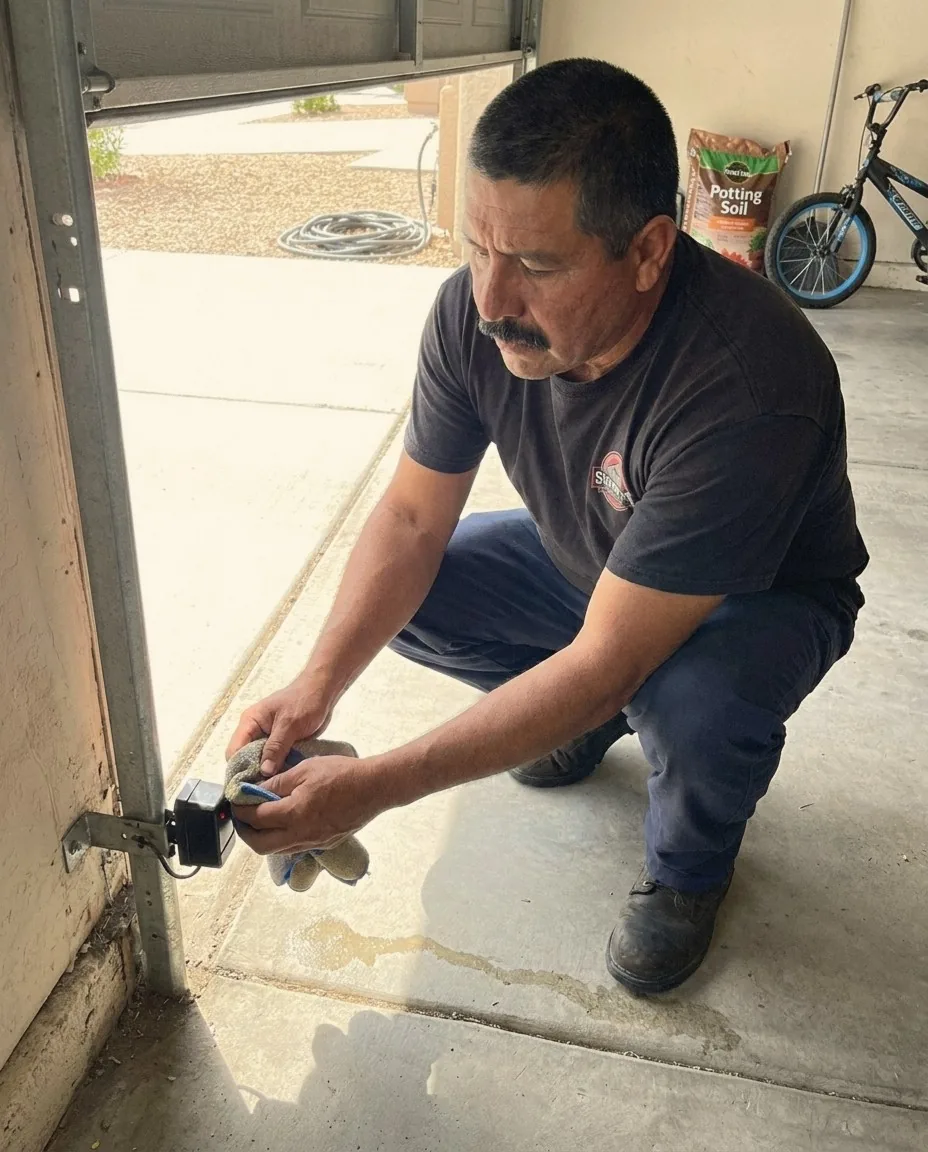
A Chamberlain garage door opener flashing light that blinks 10 times when you press the button is reporting a safety reversing sensor problem, and the door will not close from the remote until the sensors see each other again. Chamberlain’s flashing light article says to start with alignment: the two sensors sit on either side of the door no higher than 6 inches above the floor, usually on the tracks, and each has its own LED. The sending sensor shows amber, the receiving sensor shows green, and the green one must be steady. Loosen the wing nut, point the lenses at each other, and tighten once the green LED stops flickering. If the lights are steady and the door still will not close, check the wiring at the back of the motor unit (white to the white terminal, white/black stripe to the grey terminal) and the full run of wire for staples or a splice that has corroded. Step-by-step alignment for Las Vegas garages is on the Supreme Garage Doors guide to how to align garage door sensors.
Two details catch people out. If the light flashes 2 times instead of 10, that is not a sensor fault; it is the LOCK button on the wall control, covered below. And on Chamberlain openers made before February 3, 2022, you can close the door once with the sensors faulted by pressing and holding the wall control push bar until the door is fully down; Chamberlain removed that override from openers and replacement logic boards manufactured after that date, so a newer unit will not close at all until the sensors are fixed.
Why does the door reverse right after it starts closing?
A Chamberlain door that starts down and comes straight back up is being stopped by the sensor beam, by something in its path, or by a door that binds. The arrow code tells you which: 1-1 is the sensors (10 flashes on the light), 4-1 is an obstruction or a binding door. Check in this order:
- Clear the threshold, including the weather seal and anything leaning against the track.
- Watch the sensors while the door closes. A green LED that flickers as the door moves means a loose bracket or a track that vibrates the sensor out of line.
- If the door reverses at the same spot every time with nothing in the way, test the door by hand. Pull the red release cord only with the door fully closed, then lift. A door that feels heavy, jerks or sags is a spring problem: stop and call a technician. A door that moves but catches at one spot has a dragging roller, a bent hinge or a track knocked out of plumb, all of which trip the opener’s force sensing.
- Only then look at force and travel. The Supreme Garage Doors guide to adjusting garage door opener sensitivity explains why raising the force to push through a binding door is the wrong fix.
Why does the remote work but the wall button does not?
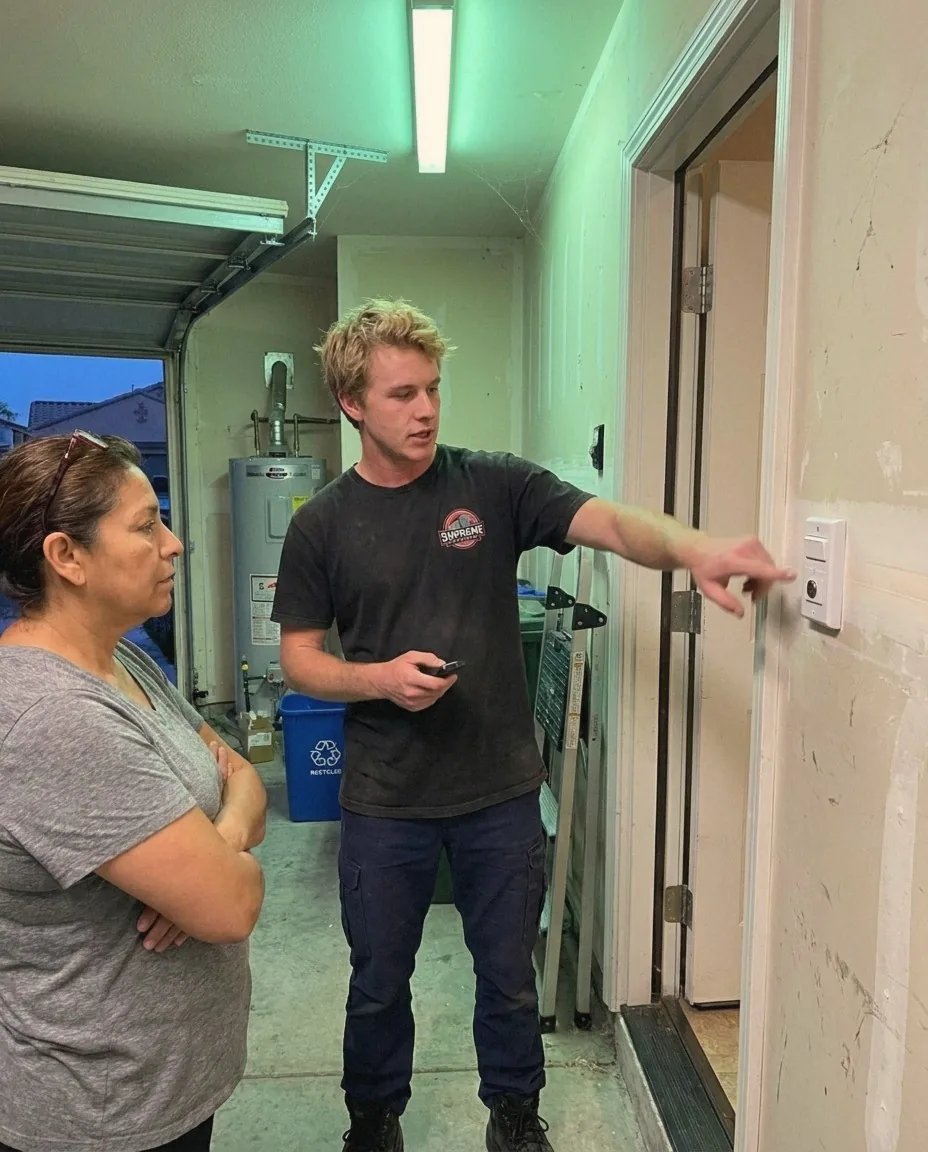
When a Chamberlain remote opens the door but the wall button does nothing, the fault is in the wall control or its two-wire run back to the motor unit. On older openers the LEARN LED shows 3 flashes for this. Chamberlain’s test is to look for a short along the wire (a staple driven through it during a renovation is the classic cause) and, if the wire is clean, replace the wall control. The opposite symptom is more common and simpler: the wall button works but the remotes do not. That is either LOCK mode (the opener light flashes 2 times when you press a remote; press and hold LOCK on the wall control to turn it off, then test again), a dead remote battery, or a remote that was erased and needs reprogramming to the LEARN button. Chamberlain’s note on LOCK is worth repeating: with LOCK on, the wall control still works normally, only the remotes are locked out, which is why a family member can usually open the door from inside while the car remote fails in the driveway.
Why is my Chamberlain garage door opener not working at all?
A Chamberlain garage door opener that shows no light, no sound and no arrow flashes has lost power or its logic board. Check in this order:
- The plug in the ceiling outlet; vibration works them loose.
- The outlet itself, with a phone charger or a lamp.
- Any GFCI reset button in the garage, a bathroom or outside. Garage outlets are often GFCI-protected, and a tripped reset elsewhere on the circuit can kill the ceiling outlet.
- The breaker.
- If the opener has power but shows a 2-1 to 2-5 code and responds to nothing, unplug it for 5 seconds and plug it back in. Chamberlain’s guidance is that a code that returns after the power cycle means the logic board needs replacement, a technician job on most models.
- A Chamberlain opener that lights up and clicks once but never moves may simply be an overheated motor. Chamberlain’s instruction for AC units is to let it cool for 45 minutes before deciding anything else is wrong.
Why is the opener humming but the door not moving?
A Chamberlain opener that hums or clicks while the door stays put is being asked to lift a door it cannot move, and the right response is to stop pressing the button. Chamberlain’s code for this is 1-5 on the arrows or 5 flashes on the LEARN LED, and its list of causes starts with a broken spring and an unbalanced door, then a manual lock still engaged, a trolley jammed against the stop bolt, and stripped drive gears. Look up at the torsion spring on the shaft above the door: a visible gap in the coil means the spring has broken, and the opener and anyone lifting by hand now carry the door’s full weight. Do not pull the emergency release and do not try to lift the door by hand in that condition. Supreme Garage Doors handles garage door spring repair across the valley, and a spring that broke while the opener was running has often also stripped the opener’s gear, so both are checked on the same visit. Only when the spring is visibly intact: if the door lifts smoothly by hand with the release pulled (door fully closed first), the problem is inside the opener (gear and sprocket kit, capacitor, or motor), which is also technician work.
myQ and Wi-Fi problems
A Chamberlain opener that works from the wall and the remote but shows offline in the myQ app has a network problem, not a door problem. Chamberlain’s Wi-Fi opener article explains the green LED on the motor unit: blinking green means the opener reached the router but could not reach the myQ server, and the fix is to power-cycle the opener, then the router, until the LED goes solid green. myQ needs a 2.4 GHz network with a usable signal at the opener; a router at the far end of the house, several walls away from the garage, is the usual reason the signal never settles. If the router was replaced or the Wi-Fi password changed, Chamberlain’s router change article says each myQ device must be set up again individually in the app. None of this affects the door itself, so a door that will not close from the app but closes from the wall is a sensor or LOCK issue first, and an app issue second.
Las Vegas specifics: dust, direct sun and summer heat
Chamberlain openers in Las Vegas fail the same ways they fail anywhere, but three local conditions push them toward the sensor and heat faults above. The first is dust. The 4-flash fix in Chamberlain’s own documentation is to clean the sensor lens, and on Las Vegas service calls Supreme Garage Doors technicians routinely find a film of fine desert dust, sprinkler overspray marks, or cobwebs across the lens of a sensor that is otherwise perfectly aligned. A dry microfiber cloth once a season keeps the green LED steady. The second is direct sun. Chamberlain states that sunlight shining into the receiving sensor (the green one) can block the signal from the sending sensor, and in the valley a low morning or evening sun pours straight through an open garage door for weeks at a time on east- and west-facing homes. When that is the pattern (door refuses to close at the same hour each day, works fine at noon), the technician’s fix is to swap the sending and receiving sensors so the green receiving eye faces away from the sun, or to shade it.
The third is heat. The National Weather Service office in Las Vegas puts the normal July high at 104.5 F and the record at 120 F (July 7, 2024), with 78.2 days a year at or above 100 F and 47.2 nights that never drop below 80 F (NWS Las Vegas temperature overview, 1991 to 2020 normals). An uninsulated attached garage holds that heat into the night, and the opener’s logic board, capacitor and motor live in it. Chamberlain’s own 45-minute cool-down instruction for an overheated motor is the manufacturer’s acknowledgment that heat alone can stop an opener. Supreme Garage Doors sees the practical result every summer: openers that stop on the hottest afternoons and run again once the garage cools. An insulated door and a sealed house door help the whole garage; so does giving an opener that has stopped in the heat time to cool before assuming the board has failed.
What you can safely do yourself vs. what needs a technician
This is the line Supreme Garage Doors draws on Chamberlain opener calls in Las Vegas. The left column is low-risk work with the opener unplugged where noted; the right column involves stored spring energy, cables under tension, or the opener’s drive train, and Chamberlain’s own documentation tells homeowners not to adjust springs themselves.
| Safe to do yourself | Stop and call a licensed technician |
|---|---|
| Replace the remote or keypad battery; reprogram a remote to the LEARN button | Broken, stretched or gapped torsion spring; door suddenly heavy or crooked |
| Turn off LOCK mode on the wall control | Frayed, slack or unwound lift cables, or a cable off its drum |
| Clean and realign the safety sensors; tighten the wing nuts; clear the beam | Opener hums but does not move (code 1-5 / 5 flashes): gear and sprocket kit, capacitor or motor |
| Check the plug, outlet, GFCI reset and breaker | Logic board replacement (codes 2-1 to 2-5 that return after a power cycle, or 6 flashes) |
| Unplug the opener for 5 seconds to clear a code, and wait 45 minutes if it ran hot | Travel module faults (codes 4-3 and 4-5) and any opener still misbehaving after the travel limits are reset |
| Lubricate rollers and hinges with a garage door lubricant (not grease on the tracks) | Door off its track, bent track, or a door that binds at the same spot by hand |
| Reconnect the emergency release on a balanced door with intact springs | Wall control wiring faults that are not a visible staple or loose terminal |
| Reset travel limits following the owner’s manual, after the door moves freely by hand | Any Chamberlain opener that fails the monthly safety reversal test in the owner’s manual (the closing door must reverse off a 1-1/2 inch board laid flat on the floor) even after the force is set per the manual |
When to call Supreme Garage Doors
Supreme Garage Doors operates as Supreme Garage Door LLC, licensed by the Nevada State Contractors Board (license 0091799, C-3D Overhead Doors), and repairs Chamberlain openers across Las Vegas, Henderson, North Las Vegas, Sunrise Manor, Whitney, Enterprise and Spring Valley. Call (702) 356-1697 with the arrow code or flash count and the technician arrives knowing what to bring. Every job gets a written quote before any work. Opener faults that trace to the door itself are covered on the garage door repair page, and when a logic board, gear kit and motor on an old unit add up to more than the opener is worth, the garage door opener installation page explains the replacement options. Neighborhood coverage is detailed on the Henderson and Spring Valley pages.
Frequently asked questions
What does it mean when a Chamberlain garage door opener blinks 10 times?
Ten flashes of the opener light means a safety reversing sensor problem, per Chamberlain’s support documentation. Clear anything in the beam, clean both lenses, and realign the sensors until the green receiving LED is steady; if that fails, check the sensor wires at the motor unit (white to white, white/black stripe to grey) and along their run for a staple or break.
How do I reset a Chamberlain garage door opener?
Unplug the opener for 5 seconds and plug it back in. Chamberlain gives this as the fix for a 5-flash code after a normal run and as the first step for the 2-1 to 2-5 “no response” codes. A code that comes back after the power cycle points to a hardware fault (logic board or a mechanical stoppage) rather than something a reset will clear.
Why does my Chamberlain remote not work but the wall button does?
Usually LOCK mode: the opener light flashes 2 times when you press the remote, and the remotes are locked out while the wall control still works. Press and hold LOCK on the wall control to turn it off. If the light does not flash twice, replace the remote battery, then reprogram the remote to the LEARN button on the motor unit.
Why will my Chamberlain garage door open but not close?
Because the safety sensors are blocked, misaligned, dirty or miswired; the opener will always open but refuses to close when it cannot confirm the beam. The arrow code is 1-1 or 1-2 and the light flashes 10 times. On openers made before February 3, 2022, holding the wall control push bar closes the door once as an override; newer units have no override and must have the sensors fixed first.
Can I fix a Chamberlain opener that hums but does not move?
Not safely. The hum (code 1-5 or 5 flashes) means the opener cannot move the door, and Chamberlain lists a broken spring and an unbalanced door as the first causes. Stop pressing the button, look for a gap in the torsion spring above the door, and call a licensed technician; spring, cable and drive gear work is not a homeowner repair.
About Supreme Garage Doors
Supreme Garage Doors is a locally owned garage door repair and installation company serving the Las Vegas valley, including Henderson, North Las Vegas, Sunrise Manor, Whitney, Enterprise and Spring Valley. The team handles broken springs, off-track doors, cables, rollers, panels, opener repair and installation, and new insulated, carriage house and glass doors from Amarr, Clopay and Wayne Dalton, 24 hours a day, 7 days a week, with same-day service on most calls and a written quote before any work. Supreme Garage Doors operates as Supreme Garage Door LLC, licensed by the Nevada State Contractors Board (license 0091799, C-3D Overhead Doors). Call Supreme Garage Doors at (702) 356-1697.