A wind-rated garage door in Las Vegas is a door pressure tested and labeled to resist the design wind pressure Clark County assigns to your lot, not a door “rated for 100 mph”. The county’s current residential code sets that pressure. The Southern Nevada Amendments to the 2024 International Residential Code (in force since January 11, 2026) list an ultimate design wind speed of 98 mph for the whole valley below 3,900 feet and tell applicants to assume wind Exposure C unless they prove otherwise. For a new or replacement door that means a labeled design pressure in the mid teens of pounds per square foot on a typical two-car door. Supreme Garage Doors installs those doors and, just as often, is asked whether a 2000s builder door on a windy lot near the Spring Mountains needs bracing. Both answers are below, with the county’s own numbers.
What Clark County actually requires
Clark County sets garage door wind requirements through Table R301.2 of its amended residential code, and the number changed with the 2024 cycle. The 2018 IRC amendments (effective February 4, 2019) listed 115 mph for elevations under 6,000 feet. The 2024 amendments, adopted July 15, 2025 and effective January 11, 2026, list 98 mph for all four elevation bands below 3,900 feet, with topographic effects, special wind region and windborne debris zone all marked “No”. The lower figure follows the ASCE 7-22 wind map the 2024 code uses; the valley did not get calmer. Footnote d is the part homeowners never see: wind exposure “shall be selected as category C unless the applicant provides a detailed justification”. Exposure C is open terrain with few obstructions, and it raises the pressure a door must carry compared with the suburban Exposure B most national charts assume.
The garage door itself is covered by IRC section R609.4, which requires doors to be tested to ASTM E330 or ANSI/DASMA 108, and by R609.4.1, which requires a permanent manufacturer label showing the model, the positive and negative design pressure rating, the installation drawing reference and the test standard. The Door and Access Systems Manufacturers Association (DASMA) explains the rule in Technical Data Sheet 1502: a label signifies a rating, non-rated doors get no label, and no door is sold “rated to a wind speed” because the code works in pressure, not mph. The building department is the final authority on the pressure an address needs.
From 98 mph to a design pressure: a worked Las Vegas example
Design pressure for a garage door in Las Vegas depends on wind speed, exposure category, the mean roof height of the house, the door size and where the door sits on the wall. DASMA’s Garage Door Wind Load Guide for the 2021 and 2024 IRC tabulates the result. Its chart has a 10 psf floor and is built for Exposure B, so the Exposure C that Clark County assumes is reached by multiplying by 1.48 (15 ft roof) or 1.44 (25 ft roof), as the guide’s note 5 instructs.
| Typical Las Vegas house | Door | Chart value at 100 mph, Exposure B | Clark County Exposure C (x1.48 or x1.44) |
|---|---|---|---|
| Single story, 15 ft mean roof height | 16 x 7 double | +10.0 / -10.0 psf | about +14.8 / -14.8 psf |
| Two story, 25 ft mean roof height | 16 x 7 double | +10.0 / -10.0 psf | about +14.4 / -14.4 psf |
| Two story, 25 ft | 9 x 7 single | +10.0 / -10.1 psf | about +14.4 / -14.5 psf |
The 98 mph figure sits between the guide’s 95 and 100 mph columns, which both read 10.0 psf at Exposure B, so a labeled door in the plus and minus 15 psf class covers the typical Las Vegas lot. The negative number is real: positive pressure pushes the door in, negative pressure (suction on the lee side of a gust) pulls it out, so rated doors are tested both ways.
What the wind does here, and where
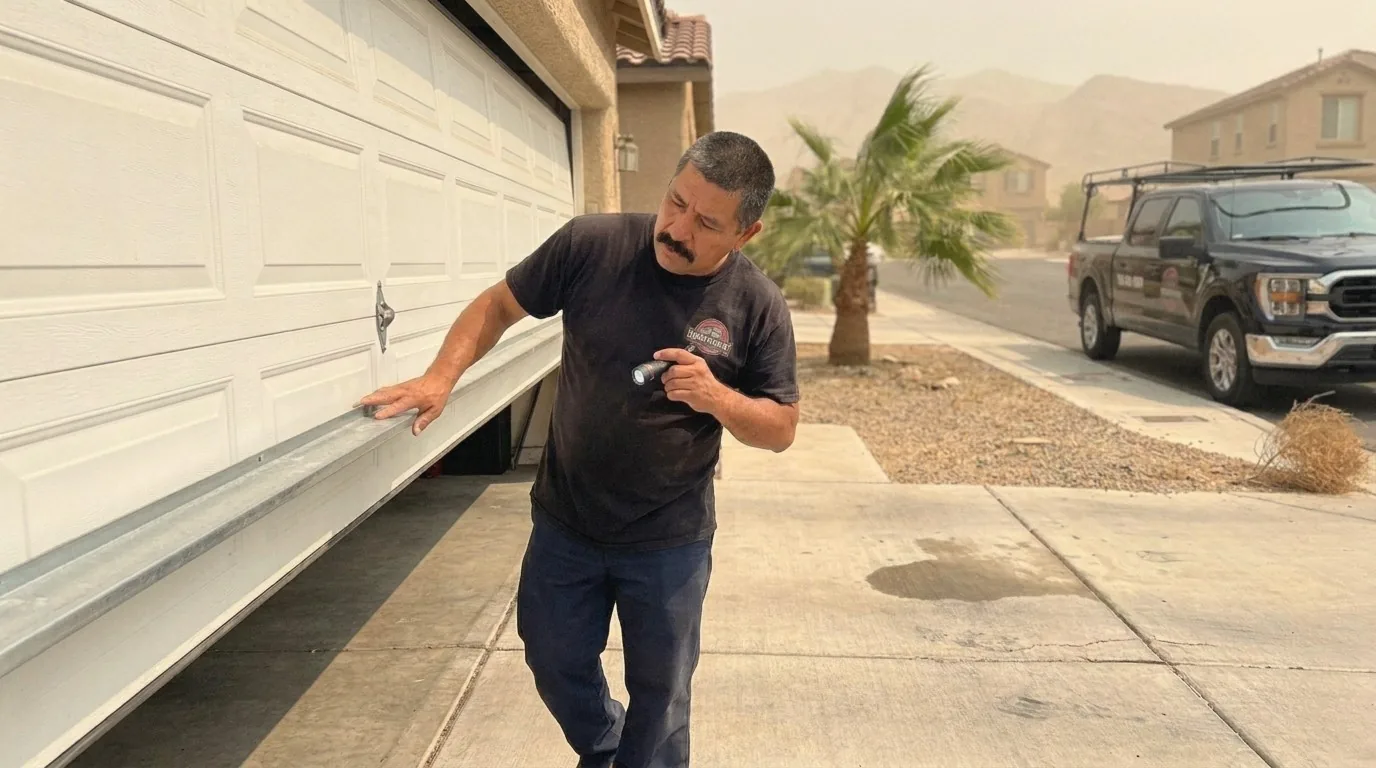
The National Weather Service office in Las Vegas says the valley’s strong winds arrive from the southwest or pass through from the northwest, most often in spring and again in fall; winds over 50 mph are infrequent but bring the blowing dust and sand that make them so disruptive. A west- or south-facing door on an exposed lot at the edge of the southwest valley, in Mountain’s Edge, Southern Highlands or the Blue Diamond corridor, takes those gusts face-on; the same door in a tight Henderson cul-de-sac is sheltered. DASMA’s wind FAQ (TDS 168) notes that compass direction does not change the code design pressure, but it does change how often an older door is loaded near its limit.
How a wind-rated door is built differently
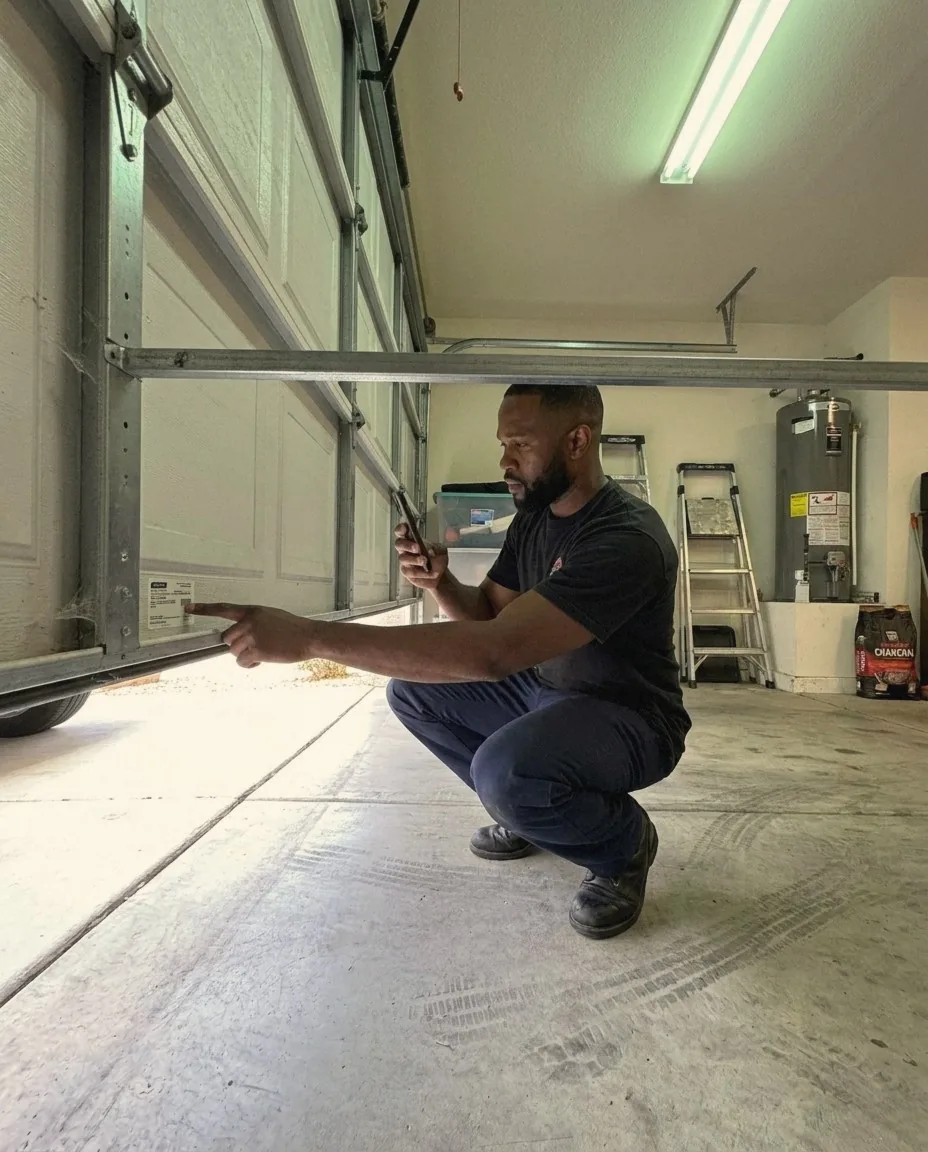
A wind-rated residential garage door in Las Vegas differs from a standard door in four ways, three of them visible from inside the garage: more and heavier horizontal steel struts (U-shaped channels bolted across the back of each section), heavier-gauge end stiles and hinges that carry the load into the track, and extra jamb brackets and track fasteners at closer spacing. The fourth is invisible: the assembly has been tested as a system to ANSI/DASMA 108 at 1.5 times its design load, which is what the label certifies. Clopay sells this as its WindCode line, ranked W1 to W9, and Amarr’s equivalent is its wind load line with WindPro ratings; Supreme Garage Doors installs both and matches the rating to the pressure the county assigns.
DASMA’s TDS 153 on vertical reinforcement makes the point that applies to any Las Vegas homeowner tempted by an aftermarket brace: a post not specified by the door manufacturer “may not result in a door that properly resists the wind”, counts as a component substitution, and can overload the header. The manufacturer’s own kit is the only bracing Supreme Garage Doors will fit.
Does an older door need bracing? A decision table
Most doors Supreme Garage Doors services in the valley were installed between 2000 and 2015, before the label rule, and many carry a single light strut on the top section. The table is how Supreme Garage Doors decides on the first visit; the county’s plans examiner decides what a permit requires.
| What the technician checks | Leave it alone | Reinforce with the manufacturer’s strut kit | Replace with a labeled wind-rated door |
|---|---|---|---|
| Wind load label on the end stile | Present, at or above the county figure | Absent, model still made with a published strut package | Absent, model discontinued |
| Door width and panels | Single 8 or 9 ft door, panels flat | 16 or 18 ft door, one strut, panels flex by hand | Panels bowed, creased or rust-pitted at the stiles |
| Lot exposure | Interior lot, shielded by neighbors | West or south facing with open desert, park or wash windward | Exposed lot and a door that already walks in its track on gusty days |
A strut kit is a modest job: the maker’s struts go on the sections that lack them, light end hinges are swapped for heavier ones, and the springs are re-tensioned because the door now weighs more. That last step is why it is not a hardware-store project; the spring work carries the hazards described on the garage door spring repair page. A replacement door arrives labeled for the lot’s pressure; see garage door installation.
What to do when a wind advisory is issued
DASMA’s TDS 192 explains why a closed door can open itself in a gust: the track is tilted back and the top rollers sit in its curve, so part of the wind force on the door face becomes upward lift. Its recommendations are the ones Supreme Garage Doors gives before a spring wind event.
- Close the door and leave it closed. TDS 192 notes that once a door opening is breached, pressure builds inside the garage and can lift the roof, the finding of the post-Hurricane Andrew studies it cites.
- Engage the manual lock if the door has one designed for wind resistance, then disconnect the opener. Unlock before the next normal use; running an opener against a lock damages both.
- After the event, if the door was open, hangs crooked or will not run, have it inspected before using the opener (DASMA TDS 175).
When to call Supreme Garage Doors
Supreme Garage Doors operates as Supreme Garage Door LLC, licensed by the Nevada State Contractors Board (license 0091799, C-3D Overhead Doors). Call (702) 356-1697 to have the wind label checked against the county figure, a strut package added to a wide builder door, or a replacement door quoted with its design pressure in writing, across Las Vegas, Henderson, North Las Vegas, Sunrise Manor, Whitney, Enterprise and Spring Valley. If the opener itself refuses to run after a windstorm or a power flicker, our Chamberlain garage door opener troubleshooting guide covers the resets and flash codes to check first.
Frequently asked questions
Does Clark County require a wind-rated garage door on a replacement?
Doors installed under the county’s residential code must be tested to ANSI/DASMA 108 or ASTM E330 and carry the R609.4.1 design-pressure label, with 98 mph and Exposure C as the design basis under the 2024 code. Whether a specific replacement needs a permit is the Clark County Building Department’s call; Supreme Garage Doors quotes labeled doors that meet the county figure.
What design pressure does a garage door need in Las Vegas?
For a typical 16 by 7 foot door, DASMA’s 2024 IRC guide gives 10 psf positive and negative at Exposure B, and the Exposure C factor Clark County assumes brings that to roughly plus and minus 14.4 to 14.8 psf. The building department confirms the number for any address.
How can I tell if my current garage door is wind rated?
Look for a permanent manufacturer label inside the door, usually on an end stile near the bottom, listing the model and a positive and negative design pressure. No label means no rating; builder doors installed in Las Vegas in the 2000s rarely have one.
Can I add my own braces or a 2×4 post to my garage door before a windstorm?
No. DASMA warns that bracing not specified by the door’s manufacturer may not resist the wind, can overload the header, and counts as a component substitution. The safe options are the manufacturer’s own strut kit, installed with the springs rebalanced, or a labeled wind-rated replacement door.
Which side of the Las Vegas valley gets the worst garage door wind damage?
The National Weather Service says the valley’s strong winds arrive from the southwest or northwest, most often in spring and fall, so west- and south-facing doors on open lots closest to the Spring Mountains, across the southwest valley and the Blue Diamond corridor, take the most direct gusts.
About Supreme Garage Doors
Supreme Garage Doors is a locally owned garage door repair and installation company serving the Las Vegas valley, including Henderson, North Las Vegas, Sunrise Manor, Whitney, Enterprise and Spring Valley. The team handles broken springs, off-track doors, cables, rollers, panels, opener repair and installation, and new insulated, carriage house and glass doors from Amarr, Clopay and Wayne Dalton, 24 hours a day, 7 days a week, with same-day service on most calls and a written quote before any work. Supreme Garage Doors operates as Supreme Garage Door LLC, licensed by the Nevada State Contractors Board (license 0091799, C-3D Overhead Doors). Call Supreme Garage Doors at (702) 356-1697.