
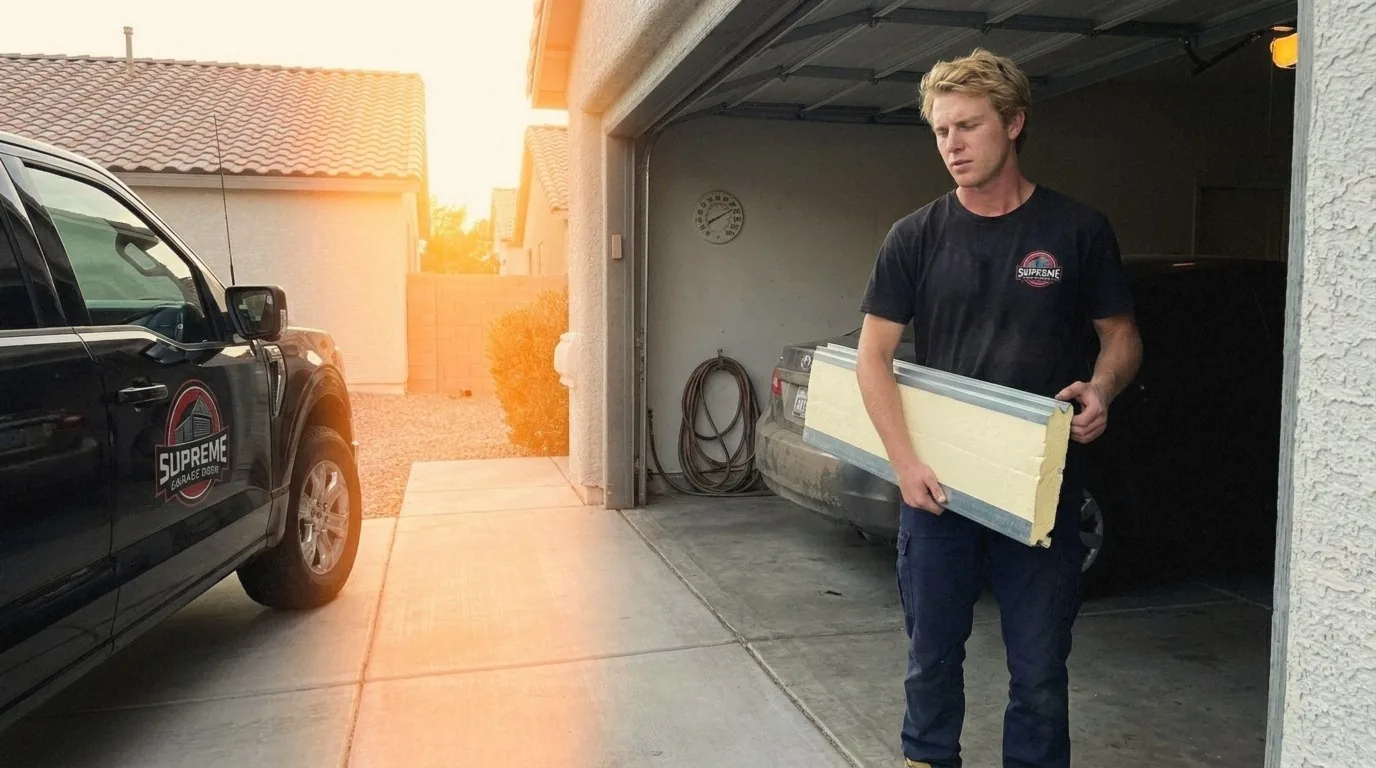
An insulated garage door helps in Las Vegas heat when the garage is attached to the house, faces west or south, or has living space above or beside it. It helps far less when the garage is detached or the shared wall is already well sealed. The size of the problem is the reason: the National Weather Service lists a normal of 78.2 days a year at or above 100 F in Las Vegas, 40.5 days at or above 105 F, and 47.2 nights that never drop below 80 F. A single-skin steel door facing the afternoon sun turns the garage into a heat reservoir that leaks into the house all evening. Supreme Garage Doors installs insulated doors across the valley and, just as often, tells a homeowner that a plain door plus a better seal on the house door is the honest fix. This guide covers what R-value and U-factor measure, which garages gain the most, and how to choose.
How hot a Las Vegas garage actually gets
What matters for a garage door in Las Vegas is how long the heat lasts, not the afternoon high on the news. The NWS Las Vegas record for 1991 to 2020 gives July normal highs of 103 to 105 F and lows of 80 to 83 F, and its count of days by temperature runs the 100 F season from May (2.8 days in a normal year) through September (7.9 days). Clark County’s 2018 residential code amendments set the summer outdoor design temperature for the valley floor at 112 F, the figure HVAC contractors size equipment against. An unconditioned attached garage sits outside that equipment’s reach, with a steel door absorbing direct sun on one side and, on the other, a shared wall the air conditioner is paying to keep cool.
Orientation decides how hard the door works. A west-facing door takes direct sun through the hottest hours of a July afternoon on top of the air temperature; a south-facing door gets the midday sun; a north-facing door, or one shaded by a two-story neighbor, mostly sees ambient heat and gains far less from insulation, which is why Supreme Garage Doors asks the orientation first. West-facing tract doors are most common on the valley’s southwest rim, in Mountain’s Edge and Southern Highlands along the Spring Mountains foothills, which is also the side the valley’s strong winds reach first; see the Southwest Las Vegas page.
R-value, U-factor and why the label number is only half the story
R-value is the number every brochure leads with, and the Door and Access Systems Manufacturers Association calls it the weaker measure. DASMA’s Technical Data Sheet 163 explains that a garage door R-value is calculated through the center of a single section (insulation thickness, foam conductivity, plus 0.85 for air films) and “should not be used for garage door assemblies” because it ignores section joints, end stiles, thermal breaks and weather seals. The tested U-factor, measured on a complete installed door to ANSI/DASMA 105, captures all of that; DASMA’s TDS 196 adds that the two are not reciprocals and that a door at U 0.20 is twice as thermally efficient as one at 0.40. Lower U-factor is better, higher R-value is better, and the two are not interchangeable.
So two doors with the same R-18 sticker can perform differently once installed. A door with a thermal break at each section joint (a non-metal strip separating the outer and inner steel skins), tight perimeter seals and no windows posts a lower U-factor than one with the same foam, steel-to-steel joints and a row of single-pane lites, and Clopay’s own technical note says exactly that. Supreme Garage Doors names the U-factor on a quote wherever the manufacturer publishes one.
The R-value ladder for the doors sold in Las Vegas
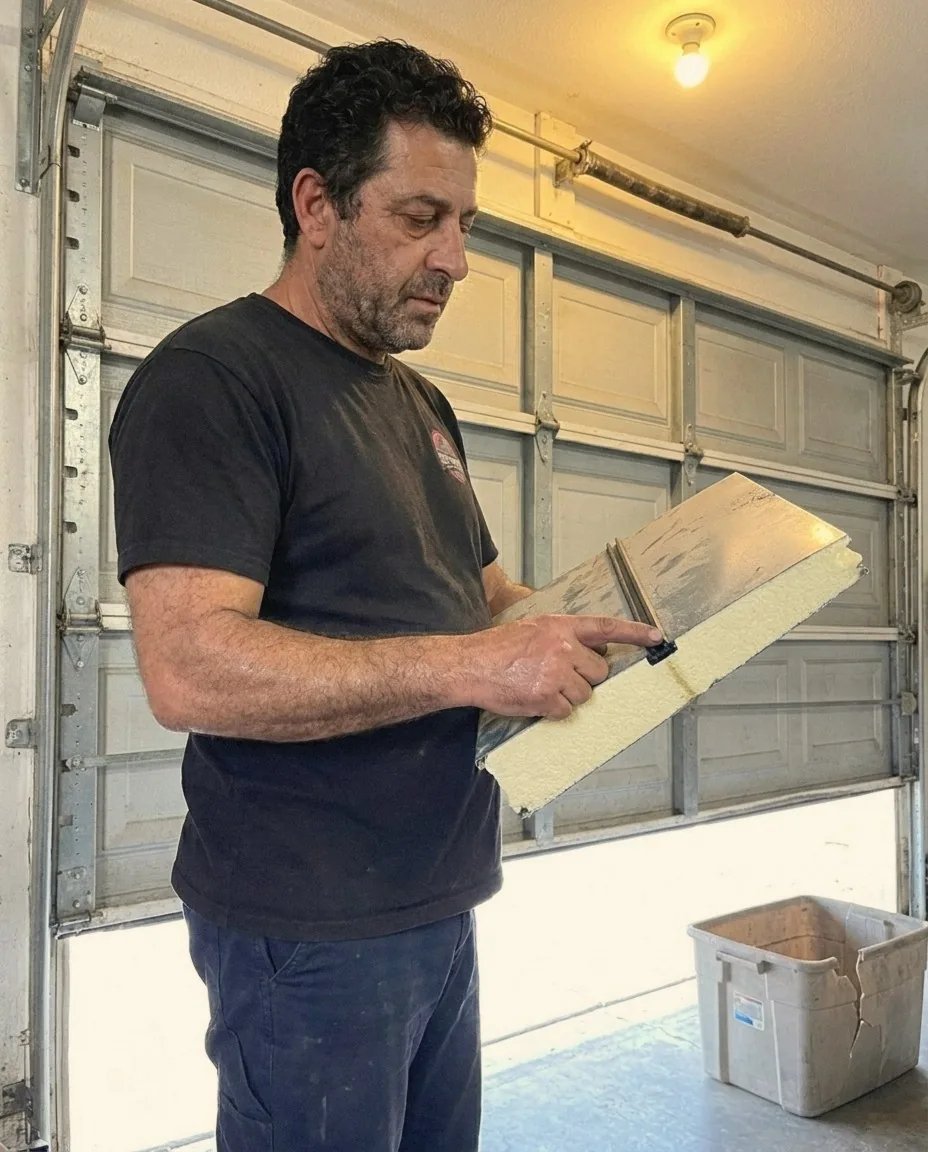
Residential steel doors come in three constructions. The R-values below are Clopay’s published figures; Amarr and Wayne Dalton build the same tiers under their own model names (Wayne Dalton lists R-9 for its three-layer 9100 and notes that its ratings are calculated section values).
| Construction | Published R-value (Clopay) | What it means in a Las Vegas garage |
|---|---|---|
| Single-layer steel, no insulation (many 2000s builder doors) | None | The steel skin reaches the temperature of the sun on it; the garage follows through the afternoon. |
| Two-layer steel with polystyrene board | about 6.3 to 6.5 | Takes the edge off radiant heat and quiets the door; joints are usually not thermally broken. |
| Three-layer steel, 1-3/8 in polyurethane foam | 12.9 | The sensible target for an attached garage; Clopay’s own guidance puts attached garages at R 10 to 13. |
| Three-layer steel, 2 in polyurethane foam | 18.4 | For west-facing doors, a bedroom over the garage, or a garage used as a gym or shop. |
The jump from no insulation to a 1-3/8 inch polyurethane door is where most of the benefit lives. Going from 12.9 to 18.4 helps on a west-facing door or a garage with a room above it; the five-layer composite doors rated to 20.4 and the full-view glass doors at about 6.3 (both from the same Clopay table) are bought for the look.
The attached garage is the real reason to insulate
The U.S. Department of Energy’s Building America program, in its guide to air sealing an attached garage, treats the garage as outside the home’s thermal and air boundary: walls and ceilings between garage and conditioned space are air sealed and insulated, the door into the house is treated as an exterior door, and the point is to “thermally isolate garages from interior occupied space” and keep garage air out of the house. In a Las Vegas tract home that boundary is often weak: a hollow-core door into the laundry room, open joist bays over the garage running into the bedroom floor above, and the water heater or air handler sitting in the garage itself. An insulated garage door lowers the temperature on the garage side of that boundary, so less leaks through it, and it is the one part of the boundary that can be upgraded in an afternoon. That also sets the limit: on a detached garage, or a single story with a solid sealed wall to the kitchen, the insulated door makes the garage quieter and more pleasant but the air conditioner will not notice, and Supreme Garage Doors says so on the quote.
Does an insulated door pay off in your garage? A decision table
This is the checklist Supreme Garage Doors runs on a Las Vegas installation estimate. Three or more answers in the first column usually mean a 1-3/8 or 2 inch polyurethane door is the right buy; mostly second-column answers mean the money is better spent elsewhere.
| Question | Points toward an insulated door | Points toward a plain door plus sealing |
|---|---|---|
| Is the garage attached? | Yes, living space on the other side of the wall | Detached, or attached only to a storage room |
| Which way does the door face? | West or south, no shade after 3 pm | North, or shaded by a neighbor or deep recess |
| Room over or beside the garage? | Bedroom or bonus room above, or a bedroom on the shared wall | Single story, kitchen or laundry on the shared wall only |
| What lives in the garage? | Water heater, air handler, second refrigerator, gym, workshop, pets | Cars and storage only |
| How is the house door? | Solid, weather-stripped and self-closing | Hollow core with daylight at the threshold: fix this first |
Four details that decide whether the insulation works
- Thermal breaks at the joints. A 16 foot door has four or five full-width section joints; steel-to-steel joints conduct heat straight past the foam.
- Windows. Lites on a west-facing door add solar gain and raise the U-factor; if the look matters, use insulated glass in the top section only.
- Perimeter seals. New jamb weather-stripping and a fresh bottom seal keep hot air from flowing around the door; desert sun dries and cracks the original weather-stripping.
- Spring sizing. A 2 inch polyurethane door weighs noticeably more than the single-skin door it replaces, so the torsion springs must be sized to the new weight; hanging it on the old hardware is the usual failure. See garage door spring repair.
When to call Supreme Garage Doors
Supreme Garage Doors operates as Supreme Garage Door LLC, licensed by the Nevada State Contractors Board (license 0091799, C-3D Overhead Doors). Call (702) 356-1697 for an insulated door quote that names the construction, the published R-value and U-factor, the thermal break and seal details, and the spring sizing, in writing before any work. New insulated doors from Amarr, Clopay and Wayne Dalton are covered on the garage door installation page, across Las Vegas, Henderson, North Las Vegas, Sunrise Manor, Whitney, Enterprise and Spring Valley. If the heavier insulated door leaves an existing Chamberlain opener straining or reversing, our Chamberlain garage door opener troubleshooting guide covers the force and travel checks to run before assuming the motor is done.
Frequently asked questions
Does an insulated garage door keep a Las Vegas garage cool?
Cooler than a single-skin steel door, especially on a west- or south-facing wall, but it does not air-condition the space. With 78 days a year at 100 F or more the garage still runs hot; the insulated door lowers the peak and slows the heat that leaks through the shared wall into the house.
What R-value should a garage door have in Las Vegas?
For an attached garage, the 1-3/8 inch polyurethane construction published at R-12.9 is the sensible target, in line with Clopay’s R 10 to 13 guidance for attached garages; choose the 2 inch R-18.4 construction for a west-facing door or a bedroom over the garage. Ask for the tested U-factor as well, since DASMA says R-value alone does not describe the installed door.
Is R-value or U-factor more important for a garage door?
U-factor. DASMA’s Technical Data Sheet 163 states that calculated R-value covers only the center of a section and should not be used for complete door assemblies, while the tested U-factor (ANSI/DASMA 105) measures the whole installed door. Lower U-factor is better.
Is polyurethane or polystyrene better for Las Vegas heat?
Polyurethane. It is foamed in place, bonds to both steel skins, and reaches R-12.9 to R-18.4 where polystyrene board reaches about R-6.3 to R-6.5, and polyurethane doors usually come with thermal breaks at the joints, which matter as much as the foam.
Will an insulated garage door lower my power bill in Las Vegas?
Only if the garage is attached and heat is reaching conditioned space through the shared wall, ceiling or house door. The Department of Energy’s Building America guidance treats that boundary as the priority; sealing the house door and the joist bays above the garage is usually the cheaper first step.
About Supreme Garage Doors
Supreme Garage Doors is a locally owned garage door repair and installation company serving the Las Vegas valley, including Henderson, North Las Vegas, Sunrise Manor, Whitney, Enterprise and Spring Valley. The team handles broken springs, off-track doors, cables, rollers, panels, opener repair and installation, and new insulated, carriage house and glass doors from Amarr, Clopay and Wayne Dalton, 24 hours a day, 7 days a week, with same-day service on most calls and a written quote before any work. Supreme Garage Doors operates as Supreme Garage Door LLC, licensed by the Nevada State Contractors Board (license 0091799, C-3D Overhead Doors). Call Supreme Garage Doors at (702) 356-1697.